

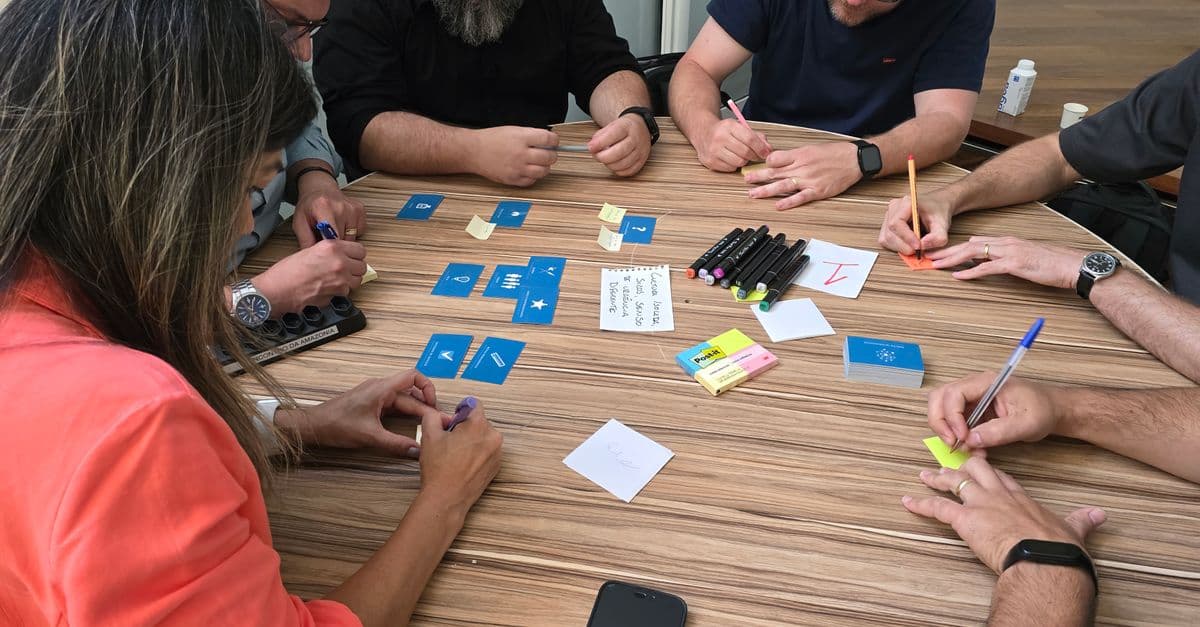
Co-Design Session Facilitator
Structure co-design workshops and synthesize stakeholder insights into design artifacts
What You Can Do
You can design tailored session frameworks for diverse participant groups, generate real-time synthesis prompts that surface latent needs during discussions, and immediately produce actionable design artifacts from raw session notes. Claude helps you maintain psychological safety and creative momentum while ensuring all voices—including marginalized participants—shape design outcomes, whether sessions are synchronous or asynchronous.
Features
Create structured co-design agendas tailored to participant profiles, objectives, time constraints, and accessibility needs
Generate targeted questions that surface latent needs, unspoken assumptions, and breakthrough insights during live discussions
Transform raw session notes into polished personas, journey maps, opportunity statements, and empathy maps
Facilitate distributed stakeholder engagement when synchronous meetings aren't feasible, maintaining continuity across sessions
Build facilitation approaches that ensure underrepresented voices and marginalized perspectives shape solutions directly
Generate psychologically safe session guardrails and communication norms tailored to your stakeholder group
Bridge silos between engineering, marketing, customer success, and other teams during co-design
Maintain synthesis rigor across multiple sessions with standardized prompts and extraction templates
Example Output
Session Framework Output:
- Opening: 15-min icebreaker ("Share a time someone didn't listen to you")
- Ideation: 45-min divergent brainstorm with tactile prototyping materials
- Synthesis: 30-min guided debrief using specific prompts
Extracted Persona: Maria, 34, Healthcare Admin — Frustrated by fragmented patient scheduling systems that force her to context-switch 12+ times daily. Needs: One unified dashboard. Pain: "I lose 2 hours daily to manual coordination."
Opportunity Statement: How might we reduce cognitive load for healthcare administrators so they can spend more time on patient relationships instead of system management?
What's Included
- SKILL.md instruction file for Claude's co-design facilitation role:
- Session framework template with customizable agendas, ice-breakers, and closing rituals:
- Real-time synthesis prompt library organized by design stage (discovery, ideation, refinement):
- Design artifact extraction checklist for personas, journey maps, opportunity statements, and empathy maps:
- Equity practices guide with facilitation moves for psychological safety and inclusive participation:
Who It's For
- UX/UI designers and design researchers running participatory design sessions with users and stakeholders
- Product managers and cross-functional leads facilitating co-creation workshops across engineering, design, and marketing teams
- Social impact and civic tech practitioners designing directly with vulnerable or underserved communities
- Healthcare and human services designers conducting co-design with patients, families, and frontline staff
- Design consultants and facilitators managing multiple concurrent stakeholder sessions with consistency requirements
Best For
- Structuring co-design workshops with diverse participant groups to ensure psychological safety and creative momentum
- Extracting personas, journey maps, and opportunity statements from raw session notes in real-time
- Generating synthesis prompts that surface latent needs and breakthrough insights during live discussions
- Facilitating asynchronous co-design across geographically distributed or time-constrained stakeholders
- Building equity into facilitation by ensuring marginalized voices and underrepresented perspectives shape outcomes
You might also like
You can rapidly build responsive, production-ready UI designs using Tailwind's utility-first approach. Apply low-level utility classes directly to HTML elements to create custom designs without writing CSS, implement mobile-first responsive layouts, add dark mode and theme customization, and generate optimized CSS bundles through build-time processing that includes only the classes you actually use.
 by calesthio
You can diagnose why layouts break at specific breakpoints and receive precise CSS fixes to resolve them. The skill identifies root causes of overflow problems, flex/grid misalignment, and mobile usability failures, then provides responsive design patterns to prevent similar issues from recurring across your entire project.
by calesthio
You can generate detailed interaction specifications for complex user flows and component behaviors that eliminate ambiguity in handoff. The skill produces structured documentation including state diagrams, transition tables, animation timing, keyboard navigation patterns, error handling workflows, and accessibility requirements—all formatted for both designers and developers to reference.
by calesthio
You can systematically evaluate your design system's health using structured frameworks that assess component consistency, design token usage, documentation completeness, and developer adoption. The skill generates prioritized gap analysis reports that quantify issues—like duplicate components, token sprawl, or implementation friction—and translates findings into executive-ready roadmaps with business cases for remediation. You'll move beyond subjective design assessments to data-backed improvement strategies.
by calesthio
You can consolidate mixed usability research data—behavioral notes, task completion rates, error logs, participant quotes, and video timestamps—into a unified issue framework with severity classifications, root cause analysis, and remediation recommendations. This skill creates hierarchical issue inventories that communicate findings to stakeholders with clarity, establishing shared language around problem severity and impact across cross-functional teams.
by calesthio
You can generate customized interview frameworks that assess design ops candidates against specific competencies aligned with your team's maturity and challenges. The skill produces behavioral interview questions, technical scenario assessments, and scoring rubrics that help interview panels evaluate candidates objectively across process optimization, metrics thinking, tool knowledge, and organizational influence—moving beyond portfolio review to predict job-ready performance.
by calesthio
You can write clean, maintainable Tailwind CSS directly in React JSX using utility-first principles. This skill helps you compose responsive layouts, implement dark mode themes, extract reusable component patterns, convert existing CSS to Tailwind, and troubleshoot Tailwind configuration issues. It's optimized for dashboards, forms, cards, modals, and other typical application interfaces.
by calesthio
Conduct comprehensive culture assessments that go beyond pulse surveys to uncover hidden friction points impacting designer satisfaction and retention. You'll quantify culture health across key dimensions like psychological safety, autonomy, growth opportunity, and collaboration effectiveness, then generate prioritized improvement roadmaps with specific interventions backed by team feedback. This framework helps you build evidence-based business cases for culture investments and track improvements across quarterly cycles.
by calesthio